

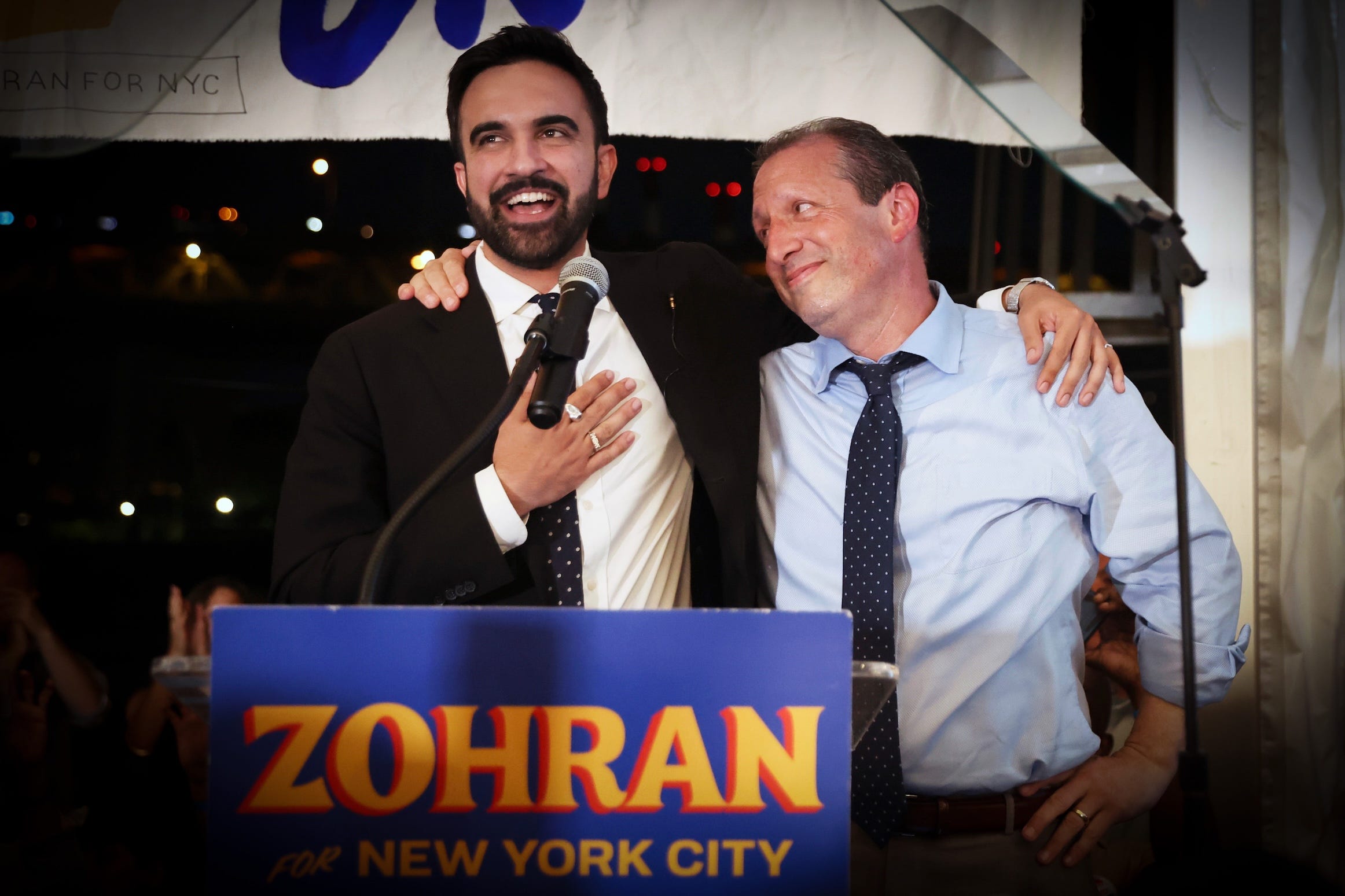
On November 4th, 2025, Zohran Mamdani won the mayoral election of the most Jewish city in the world, earning just over 50% of New York’s vote.1 Among Jewish New Yorkers in particular, an estimated 31% supported Mamdani’s candidacy.2 In fact, Jews were some of Mamdani’s most enthusiastic and visible advocates. Yet, nationally, the organized Jewish community—across all major denominations—launched a historical and perhaps even unprecedented campaign opposing and warning about his potential mayoralship.
Mamdani’s consistent affiliations with radically anti-Israel, anti-Jewish, and at times openly pro-terrorist groups, his centering of anti-Zionism in his own politics, and his soaring popularity among Democrats3 undoubtedly raises profound questions about the future of the Democratic Party and the place Zionism and Zionists will have within it. But the disturbing nature of Jewish support for Zohran, too often devoid of communal concern, forces a difficult discussion about the boundaries of the Jewish community and a reckoning with those who abandoned it.
Mamdani’s Politics
Mamdani’s intimate relationship with pro-terrorist, anti-Israel radicalism spans his entire life, beginning in his childhood and continuing into his political career. During the Second Intifada, Zohran’s father, Mahmood, now a Columbia professor, published a book in which he defended suicide bombing, lamenting that these so-called “soldier(s)” had been “stigmatized” in America. He even cited a Palestinian terrorist as his primary example.4 In 2001, Mahmood reminisced about reading his scholarly work to young Zohran at bedtime.5
As an undergraduate at Bowdoin College, Zohran co-founded a chapter of Students for Justice in Palestine (SJP).6 According to a 2016 study, one of the strongest predictors of Jewish hostility on university campuses was the presence of an active SJP chapter.7 The organization would go on to glorify October 7th as “a historic win for Palestinian resistance.”8 They were also the progenitors of the pro-terrorist demonstrations that permeated American university campuses following Hamas’ attack.
In 2017, during his brief stint as a ‘musician’, Mamdani rapped about his “love” for the convicted leaders of a U.S. designated terrorist organization involved in funding Hamas.9
That same year, Mamdani joined the Democratic Socialists of America (DSA), forming an alliance that would define the next eight years of his political life. The DSA’s views range from excusing terrorism to outright celebrating it. In the immediate days following Hamas’ October 7th attack, numerous DSA chapters posted statements in support of “the Palestinian resistance,” with one chapter hailing the massacre as “an unprecedented anti-colonial struggle.” On the day of the attack, DSA national urged members to join protests and singled out then Assemblyman Zohran Mamdani—by name—as an exemplar of political activism.10 A week later, Mamdani was arrested at a DSA-advertised anti-Israel protest outside Senator Chuck Schumer’s home. Speaking at a 2023 DSA event, Mamdani stated that “Palestinian liberation” lay at the “core” of his politics and credited the DSA’s position on the issue as the reason he joined the organization.11
Throughout the war in Gaza, the DSA continued to broadcast its terrorist sympathies. Earlier this year, one of DSA’s committees posted “Free Elias Rodriguez” following Rodriguez’s murder of two Israelis in Washington, D.C.12 The organization affirmed “Iran’s right to self-defense”13 and, in a later deleted statement, “mourn[ed] and honor[ed]” Hamas chairman Ismail Haniyeh following his assassination.14
These statements did nothing to dissuade Mamdani. Throughout his political career, Zohran worked in tandem with the organization building a relationship that only intensified during his mayoral run. Days after launching his campaign, Zohran called the DSA his “political home.”15 His inner circle is littered with current and former DSA members and leaders16 who maintain “consistent and seamless communication” with the group, meeting weekly. The DSA was integral to his victory, practically running his campaign. They provided the initial hundreds of volunteers for Mamdani’s canvassing events and recruited many more. At the request of his staffers, the DSA began text-and-phone banking and spearheaded a robust tabling initiative aimed at young voters.17 Zohran Mamdani is not only the political product of the DSA, his electoral success can largely be attributed to his partnership with the organization.
The character of this partnership was on full display during a DSA phone bank held two days before the election and funded directly by Mamdani’s campaign. Jeremy Corbyn was tapped to lead the effort. For those unfamiliar, Corbyn is the former leader of the UK Labour Party, where he presided over one of the worst antisemitism scandals in modern Western politics. Under his tenure, Corbyn and Labour became engulfed in a litany of antisemitic scandals leading to a number of investigations and resignations. A parliamentary inquiry concluded Corbyn had created a safe space for “those with vile attitudes towards Jewish people.”18 A separate, legally binding report, found the party to be in violation of the UK’s anti-racism laws for “unlawful acts of harassment and discrimination.”19 Nine MPs quit in protest. One called the party “institutionally antisemitic.”20 Polling identified Corbyn as “the politician of choice for anti-Semites.”21 He was eventually ousted, and his successor issued a public apology: “We have failed Jewish people.”22 This was the figure that both the DSA and Mamdani enlisted to energize his campaign.
The through-line is unmistakable: Mamdani was raised by a radical, embraced radicalism as a student, and elevated it into his political identity as an adult. Whether or not he agrees with every statement produced by these organizations, the consistency with which they espouse extremism, combined with his unwavering pattern of affiliation makes clear that his ties to anti-Israel, anti-Jewish extremism runs deep. Far from an anomaly, this brand of anti-Zionism is essential to Mamdani’s politics.
Jewish Reactions
It is no surprise, then, Mamdani’s campaign elicited strong opposition from across the Jewish community.
In the Reform movement, Rabbi Angela Buchdal of New York’s Central Synagogue, considered one of America’s “most influential Rabbis” warned that Mamdani had “contributed to a mainstreaming of some of the most abhorrent antisemitism.”23 Rabbi Joshua Davidson of the flagship reform synagogue Temple Emanu-El, penned an op-ed where he wrote that “Mamdani’s candidacy concerns me greatly.”24 Senior Rabbi Ammiel Hirsh of the Stephen Wise Free Synagogue declared that opposition to Mamdani was a Jewish “imperative.”25
Conservative Rabbi Elliot Cosgrove of Park Avenue Synagogue delivered an impassioned sermon in which he proclaimed unequivocally “Zohran Mamdani poses a danger to the security of the New York Jewish community.”26
In an unparalleled display of unity, over 1,000 rabbis and cantors across the Reform, Conservative, and Orthodox movements signed a letter warning about Zohran Mamdani’s “hostility towards Judaism and Jews.”27 Joining their clerical counterparts, the ADL, AJC, UJA, JCRC—nearly every mainstream Jewish institution—issued public warnings.28 Even the U.S. Holocaust Museum, a completely apolitical entity, felt compelled to call out Mamdani’s rhetoric.29
The response from the organized Jewish community was explicit, forceful, and unified: Zohran Mamdani posed a serious danger to Jews. Their words represented genuine fear.
Jews for Zohran
Despite this communal consensus, a number of influential Jews emerged as some of Mamdani’s most vocal champions and dedicated defenders.
Award-winning actor Mandy Patinkin and his wife released a video endorsing Mamdani explicitly “as Jews.”30 On election day, three personalities dubbing themselves “the JEWS” appeared in a campaign video alongside Mamdani, professing their support for him. They recounted their experiences canvassing for Zohran and concluded with an awkward “L’Chaim” in unison.31
One participant was Matt Bernstein, a prominent Jewish social media influencer with over 2 million followers. Throughout the campaign, Bernstein regularly posted in support of Mamdani while minimizing or outright mocking Jewish concern. He accused one Jewish activist of “instilling fear into her audience so she can sell them racism,” and similarly charged that broader communal fears were “just racist” towards Mamdani.32
A group of four progressive rabbis filmed a video wearing Zohran apparel and declared that canvassing for him “is a mitzvah,” a divine obligation.33 After the widespread rabbinic letter opposing Mamdani, a number of Jewish clergy composed a response rejecting Jewish concern and affirming the legitimacy of Zohran’s stances on Israel.34
The most prominent of Mamdani’s Jewish supporters, however, was New York City comptroller Brad Lander, who also ran for mayor himself before cross-endorsing Mamdani. The two appeared together on Colbert’s “The Late Show” where Lander fawned over Mamdani’s “inspiring” politics and rushed to his defense when Jewish concerns were raised, reminding the audience of their “remarkable” Jewish-Muslim partnership.35 Lander later embraced the label “Jew for Zohran” and publicly advocated for “a coalition of anti-Zionists and liberal Zionists,” placing himself in the latter camp.36 Lander is not new to defending politicians like Mamdani. In the words of one commentator, his attitude towards Zohran is “the culmination of years of Lander’s efforts to kosherize anti-Semitism.”37
Despite broader communal opposition, a number of prominent Jewish figures rallied to Mamdani’s side. But this support was far from benign. Through their public words and actions, these Jews routinely dismissed broader community sentiment and leveraged their Jewish identity to provide political refuge for Zohran.
Communal Boundaries
The prevalence of such troubling behavior among Mamdani’s Jewish supporters compels us to consider where the boundaries of the Jewish community lie. But I want to be clear in what follows: I am not saying that Jews must be Zionists. I am not saying Jews cannot support Mamdani. I am not advocating for expelling anti-Zionists or Mamdani supporters from the Jewish community nor am I saying anti-Zionism is in itself an illegitimate Jewish belief. And I am certainly not saying that anyone who supports Zohran or identifies as an anti-Zionist is “not a Jew.” These are impulsive, shallow ideas that only serve to undermine community and shut down necessary discussion. That is precisely the opposite of my intent.
What I am saying is something simpler, truer, but far more difficult: Judaism is fundamentally communal. Our peoplehood is built upon mutual responsibility, not merely individual self-expression. Community, in its very essence, demands and depends on a baseline of empathy among its members: a willingness to take the fears and the pain of other Jews seriously, to share in their tribulations even—especially—when one disagrees with those same Jews.
Our tradition is explicit about this obligation. The Gemara states, “All Jews are responsible for one another.”38 The sage Hillel warns, “do not separate yourself from the community.”39 Maimonides writes that even a person who is otherwise morally unimpeachable but “separates himself from the community, does not take part in their hardships…but rather goes on his own individual path…has no portion in the world to come.”40 A number of other sources share similar sentiments.41
The organized Jewish community responded to Mamdani’s candidacy with extraordinary unanimity, something almost unheard of in contemporary Jewish life. Whether one believes those fears were proportionate or misplaced, they were genuine. They were voiced by rabbis across denominations, institutions throughout the Jewish world, and even the U.S. Holocaust Museum. They emerged at a time of record antisemitism, following two years of persistent demonization and alienation, and an overbearing sense of vulnerability that can be attributed in no small part to the very organizations Mamdani affiliates with. The alarm was communal.
A Jew can disagree with that communal judgment. A Jew can think these fears were exaggerated or Mamdani misunderstood. A Jew can have concerns about Mamdani, but nevertheless feel issues like affordability take precedence. A friend of mine passionately tried to explain that Trump’s “fascism” presents the real threat to Jewish safety in America, and that Mamdani was part of the political antidote. Disagreement is not betrayal. In fact, Judaism holds constructive debate, what we call argument for the sake of heaven, as one of its highest ideals. But there is a way to carry disagreement that preserves community, and many more ways that erode it.
What corrodes the community is the dismissal of Jewish fear, the trivialization of communal alarm, the labeling of Jews as racist when they express genuine concern for their safety. What corrodes it is the repugnant mocking of that fear on social media. What corrodes it is brandishing your Jewish identity as a prop to provide political cover for your preferred candidate. What corrodes it is the audacity of declaring yourself “the JEWS” precisely to negate true Jewish communal sentiment. And what corrodes it is a public celebration on election night, while that very community is still reeling from Mamdani’s victory.
Those who behave this way, who show no care for the community’s pain, no interest in their suffering, do not get “kicked out” of the community. They have simply removed themselves from it. They remain Jews, they might still identify as Jewish, they might even attend synagogue and various Jewish events. But they are Jews outside the Jewish community. They have left Judaism.
The Troubled Committed
Rabbi Donniel Hartman provides a useful framework for understanding the Jews who engage in these different modes of disagreement. He distinguishes between the “trouble committed” Zionists and the “troubled uncommitted” anti-Zionists. For Hartman, both groups are “troubled” in the sense that they are morally frustrated with the gap between what Israel is and what they believe it ought to be. They both have deep disagreements with the Israeli government and its policies. But the “troubled committed” remain unconditionally invested in Israel. Their frustration propels them deeper into the Zionist project, shaping it, criticizing it, but most importantly, taking responsibility for its direction. By contrast, the “troubled uncommitted” have disengaged from Israel completely. They have allowed their troubleness to sever their connection to the community.42
While Hartman applies this distinction to Zionism, it can be broadened to how we think about the Jewish community in general. There are both the “troubled committed” and the “troubled uncommitted” Jews. What differentiates them is not the degree of their troubleness, but how they channel it. Hartman reminds us, it is not only acceptable to be the “trouble committed,” it can sometimes even be an ideal if it is through our troubleness, held in commitment, that we draw closer to the community and help to refine it.
Satmar vs Neturei Karta: A Case Study
A particularly illustrative example of the difference between these two types of disagreement can be found in the contrast between two staunchly anti-Zionist Hasidic groups: Satmar and Neturei Karta.
Satmar traces its anti-Zionist ideology to its founder Rabbi Joel Teitelbaum. Following his escape to America during WWII, Teitelbaum published VeYoel Moshe in 1961, an anti-Zionist manifesto methodically detailing his theological opposition to Zionism. One scholar describes VeYoel Moshe as “the most anti-Zionist and anti-Israeli Jewish text of modern Times.”43 Satmar has since become the largest Hasidic sect in the Jewish world while continuing Teitelbaum’s anti-Zionist legacy.44
Neturei Karta shares a nearly identical ideological background. Both sects had strong historical ties to the Agudat, a pre-war Orthodox anti-Zionist organization. Both possess identical theological opposition to Zionism. And both draw their ideas from Teitelbaum’s writings. Where Satmar and Neturei Karta diverge is in the vastly different approaches they take towards actualizing that opposition.
Over the years, Neturei Karta has joined forces with virtually every enemy of the Jewish people. In the 1980s, Neturei Karta corresponded with Yasser Arafat and allied themselves with the PLO. In 2001, they participated in the notorious UN Durban Conference, an “antisemitic hate fest.” In 2004, they met with the president of Iran and then attended Tehran’s infamous Holocaust denial conference. In 2009, they spent Shabbat with Hamas leader Ismail Haniyeh in Gaza. In 2018, they spoke with Hezbollah leaders. In early 2023, they met with Palestinian Islamic Jihad leaders, a group that would participate in Hamas’s attack just mere months later.
Since October 7th, the Neturei Karta have been in attendance at nearly every anti-Israel protest in the New York area prepared with their Palestinian flags and scarves on top of their Hasidic garb.45 At these protests, the Neturei Karta attempt to portray themselves as the real Jews.46 Like Lander, the Neturei Karta provides political deniability for the anti-Zionists and antisemites with whom they affiliate. When accused of harboring antisemitism, these anti-Zionists often will point to the Neturei Karta in frequent attendance at their events as undeniable proof of their innocence.47
Satmar, by contrast, maintains a principled boundary. While the sect also regularly protests against the Israeli government, you’ll never find them collaborating with enemies of the Jewish people. According to followers, the Rebbe “always insisted” that the Satmar never demonstrate alongside those “who sought Israel’s destruction” or want to kill Jews.48 Satmar also has a longstanding policy of refraining from public protest while the state of Israel is at war.49 Following October 7th, Satmar declared a community-wide “extraordinary ‘Day of Prayer’...amidst the heartbreaking loss and bloodshed of hundreds of innocent Jewish lives” and reportedly continued daily recitations of tehillim, prayers for protection, throughout the war.50
Satmar speaks fiercely against Israel, but it has reserved some of its harshest words for the Neturei Karta. The Rebbe Teitelbaum himself expelled the group back in 1967, and Satmar has consistently denounced their actions ever since. Satmar goes to great lengths to clarify “[Neutri Karta] has absolutely nothing to do with Satmar,” repeatedly expressing frustration over confusion between the groups.51 Today, Satmar’s sharpest critiques often center around Neturei Karta’s collaboration with enemies of the Jewish people:
“They are walking around the world together with…those who shout without any shame [in] support [of] the murders [of Jews], they walk with them in broad daylight with the Shtreimel and the Hasidic clothes and shout together with the haters of Israel and murderers of souls. This is a terrible desecration of [God’s name], to strengthen murderers in the name of the Holy Torah and in the name of heaven.”52
Satmar’s “troubled” anti-Zionist identity is well established, but their rhetoric and behavior reveals a complicated but notable commitment to the Jewish people. Satmar is deeply critical, profoundly troubled, yet morally and communally responsible. While their ideological stance diverges from mainstream Zionism, they do not align themselves with enemies of the Jewish people and do not permit themselves to be tokenized by our enemies. Their commitment and principled boundaries distinguish their moral disagreement from corrosive opposition.
For those curious, after much controversy, only one Satmar leader endorsed Mamdani. The others endorsed Cuomo.53
Conclusion
Mamdani’s intimate connections with radically anti-Israel groups sparked widespread fear among the organized Jewish community throughout his mayoral campaign. While some Jews did support Zohran, their advocacy often dismissed, trivialized, or even mocked these communal concerns. They invoked their own Jewish identity to minimize the perceived seriousness of Jewish alarm and to shield Mamdani from allegations of antisemitism.
The Jewish community rests upon shared empathy, collective responsibility, and genuine regard for fellow members, even those with whom one disagrees. It is not their anti-Zionism, nor their support for a particular candidate that determines their lack of standing. Rather, by failing to demonstrate any qualities essential to our community, many of Mamdani’s Jewish supporters have placed themselves outside of it.
It is entirely possible, and in some cases admirable, to be a troubled yet committed member of a community. Satmar is just one such example of a group that maintains this delicate balance. But when troubledness propels one away from the Jewish community rather than draws one towards it, and commitment falters entirely, they have abandoned the community.
The condition of these Jews is not permanent. Through conscious corrective effort, teshuva, they can, and I hope they will, return to the Jewish community. They need not relinquish their troubleness, but they must choose to hold it alongside an uncompromising commitment.
At the same time, the Jewish community itself must not forget that the demand for communal empathy extends to “troubled committed” members as well. We must make room within our spaces for disagreements and cultivate an environment that, while not normalizing or legitimizing every view, still enables Jews who hold divergent opinions to remain a committed part of communal life.
Mamdani will take office in a few short days. We will soon learn whether the fears voiced by the Jewish community materialize. If—and I believe when—they do, the Jews who supported Zohran, who downplayed the risks of his mayoralty, will be presented with another opportunity to distance themselves further from the Jewish community or to stand in solidarity with it. Ultimately, this decision does not hinge on political agreement, but on whether these Jews choose to remain part of the Jewish people.
https://apnews.com/projects/election-results-2025/new-york/
https://www.cnn.com/election/2025/exit-polls/new-york-city/general/mayor/0
https://ygo-assets-websites-editorial-emea.yougov.net/documents/New_York_Politics_poll_results.pdf
https://www.reuters.com/world/us/democrats-more-energized-2026-elections-than-republicans-reutersipsos-poll-finds-2025-11-13/
https://nypost.com/2025/07/12/us-news/mamdanis-dad-part-of-anti-israel-group-sympathetic-to-suicide-bombers/
“Good Muslim, Bad Muslim: America, the Cold War, and the Roots of Terror.” Mahmood Mamdani
https://www.nytimes.com/2025/10/08/nyregion/zohran-mamdani-israel-palestine.html
https://nypost.com/2025/07/13/us-news/radical-college-group-mamdani-co-founded-wanted-justice-for-convicted-terrorist-deported-from-us/
https://www.brandeis.edu/cmjs/noteworthy/ssri/hotspots-antisemitism.html
https://www.adl.org/resources/backgrounder/students-justice-palestine-sjp
https://www.ajc.org/news/what-is-students-for-justice-in-palestine-the-hamas-supporting-anti-israel-group-being-banned
https://www.dsausa.org/statements/end-the-violence-end-the-occupation-free-palestine/
https://www.nytimes.com/2023/10/12/opinion/columnists/israel-gaza-massacre-left.html
https://dsasf.org/dsa-sf-statement-on-palestine/
https://www.thenation.com/article/activism/quit-dsa-gaza-israel/
https://www.dsausa.org/blog/why-palestinians-engage-in-armed-struggle/
https://abc7ny.com/post/palestine-nyc-protest-times-square/13908073/
https://x.com/nycDSA/status/1712981973042446575
Note: DSA national later condemned the killing, though there is no indication this committee was expelled from the group and it appears to still remain active https://www.liberationcaucus.org/
https://international.dsausa.org/statements/dsa-affirms-irans-right-to-self-defense/
https://www.jpost.com/diaspora/article-813777
https://x.com/ZohranKMamdani/status/1855331026387829018
https://www.theguardian.com/us-news/2024/oct/23/who-is-zohran-mamdani-new-york-mayor-candidate
https://www.nytimes.com/interactive/2025/08/12/nyregion/zohran-mamdani-aides-family-staff.html
https://www.thenation.com/article/politics/zohran-mamdani-dsa-field-operations/#
https://nypost.com/2025/10/08/us-news/zohran-mamdanis-mayoral-campaign-pays-28k-to-local-democratic-socialists-of-america-for-texting/
https://www.reuters.com/article/world/uks-labour-party-not-doing-enough-on-anti-semitism-lawmakers-idUSKBN12F0UI/
https://www.timesofisrael.com/uk-probe-finds-labour-guilty-of-anti-semitic-discrimination-illegal-acts/
https://www.thejc.com/opinion/i-cannot-remain-in-a-party-that-poses-an-existential-threat-to-british-jews-jnkwudzn
https://www.bbc.co.uk/newsround/47277863
https://www.timesofisrael.com/uks-corbyn-politician-of-choice-for-anti-semites-claims-report/
https://www.nbcnews.com/news/world/we-have-failed-jewish-people-u-k-labour-party-suspends-n1245299
https://www.brookings.edu/articles/anti-semitism-british-politics-and-the-indecency-of-jeremy-corbyn/
https://www.jpost.com/american-politics/article-872387
https://www.centralsynagogue.org/about-us/our-clergy/angela-w-buchdahl
https://emanuelnyc.org/about-us/our-temple/
https://www.jpost.com/opinion/article-871647
https://jewishinsider.com/2025/10/rabbi-ammiel-hirsch-new-york-city-zohran-mamdani-mayoral-election/
https://pasyn.org/sermons/2025/on-the-record/
https://jewishmajority.org/a-rabbinic-call-to-action
https://forward.com/news/763210/mamdani-adl-globalize-intifada-bds/
https://www.jns.org/ajc-expresses-alarm-about-mamdanis-problematic-rhetoric/
https://www.jpost.com/diaspora/article-868903
https://www.jpost.com/diaspora/antisemitism/article-871281
https://www.jns.org/us-holocaust-museum-accuses-mamdani-of-exploiting-warsaw-ghetto-uprising/
https://www.instagram.com/reel/DQXh14wD41P/
https://www.jpost.com/international/article-871998
https://www.instagram.com/reel/DQpP0YpgQTq/
https://www.nbcnews.com/politics/elections/zohran-mamdanis-private-influencer-briefing-rcna240260
There are a number of examples. Below are just a sample, some of which were reposted by Bernstein rather than authored by him.
https://x.com/mattxiv/status/1986491174031601913?s=20
https://x.com/mattxiv/status/1981152732682850762?s=20
https://x.com/mattxiv/status/1937521375280832621
https://x.com/mattxiv/status/1932438516119507405?s=20
https://x.com/mattxiv/status/1937521375280832621?s=20
https://x.com/mattxiv/status/1986134130573148364
https://x.com/mattxiv/status/1979038774270001500
https://x.com/mattxiv/status/1980315415378276822
https://x.com/ZaidJilani/status/1981361331874734285?s=20
https://x.com/pleasuresystems/status/1980758951953330286?s=20
https://x.com/SamAdlerBell/status/1975389970262090048?s=20
https://forward.com/fast-forward/779821/a-second-rabbinic-letter-arguing-against-jewish-rejections-of-mamdani-enters-the-nyc-mayors-race/
https://jewsforasharedfuture.org/
https://www.jta.org/2025/11/14/politics/he-was-zohran-mamdanis-jewish-wingman-whats-next-for-brad-lander
https://www.commentary.org/seth-mandel/brad-lander-and-the-collapse-of-nycs-jewish-political-establishment/
Shevuot 39a. Various translations, simplified for brevity.. https://www.chabad.org/therebbe/letters/default_cdo/aid/92987/jewish/The-meaning-of-areivus-the-mutual-responsibility-of-Jews.htm
https://www.myjewishlearning.com/article/all-of-israel-are-responsible-for-one-another/
https://www.sefaria.org/Pirkei_Avot.2.4?lang=bi&with=all&lang2=en
https://www.sefaria.org/Taanit.11a.3?lang=bi&with=all&lang2=en
https://www.sourcesjournal.org/articles/liberal-zionism-and-the-troubled-committed
https://muse.jhu.edu/article/904508
https://scholars.duke.edu/publication/1661904
I use the term “anti-Zionism” here for succinctness but Satmar might more accurately be described as “non-Zionist”
https://x.com/NetureiKarta/status/1825905961799921756?s=20
https://www.thejc.com/opinion/a-short-guide-to-neturei-karta-the-anti-zionists-favourite-fringe-jewish-sect-plivegmd
https://www.jta.org/2016/01/12/ny/satmar-and-the-last-lion
https://www.jpost.com/diaspora/article-871113
https://www.theyeshivaworld.com/news/israel-news/2460039/rare-unity-to-fight-zionists-both-satmar-rebbes-to-attend-massive-anti-draft-protest-in-manhattan.html
https://www.jta.org/2023/10/09/israel/desperately-desperately-waiting-orthodox-group-holds-prayer-service-as-chairmans-son-is-mia-near-gaza
https://x.com/HQSatmar/status/1711196451785626020
https://www.ateretcohanim.org/there-is-no-other-hand/
https://x.com/HQSatmar/status/1718484051663700282?s=20
https://crownheights.info/jewish-news/24486/neturei-karta-so-far-right-theyre-left/
https://forward.com/fast-forward/779920/satmar-mamdani-nyc-mayor-election-endorsement/
https://belaaz.com/news/satmar-board-of-directors-rejects-mamdani-endorsement-issues-new-letter-supporting-cuomo
Great article Josh!